What Happens When All Premium Pet Brands Fight Over the Same Territory?
September 23rd, 2026 Posted by Emergent Brand differentiation, brand marketing, brand messaging, Commoditization, Validation, Value proposition 0 comments on “What Happens When All Premium Pet Brands Fight Over the Same Territory?”Innovation leverage is fading fast…
We are entering a period of uncertainty in the pet industry as underlying strategic challenges and product proliferation – accelerated by the extraordinary impact of AI – are reframing what competitive advantage looks like. Here we will pull apart and examine the forces at work, identify the impacts and launch a conversation about the next threshold of durable marketplace strength. Stay tuned for our recommendations at the end.
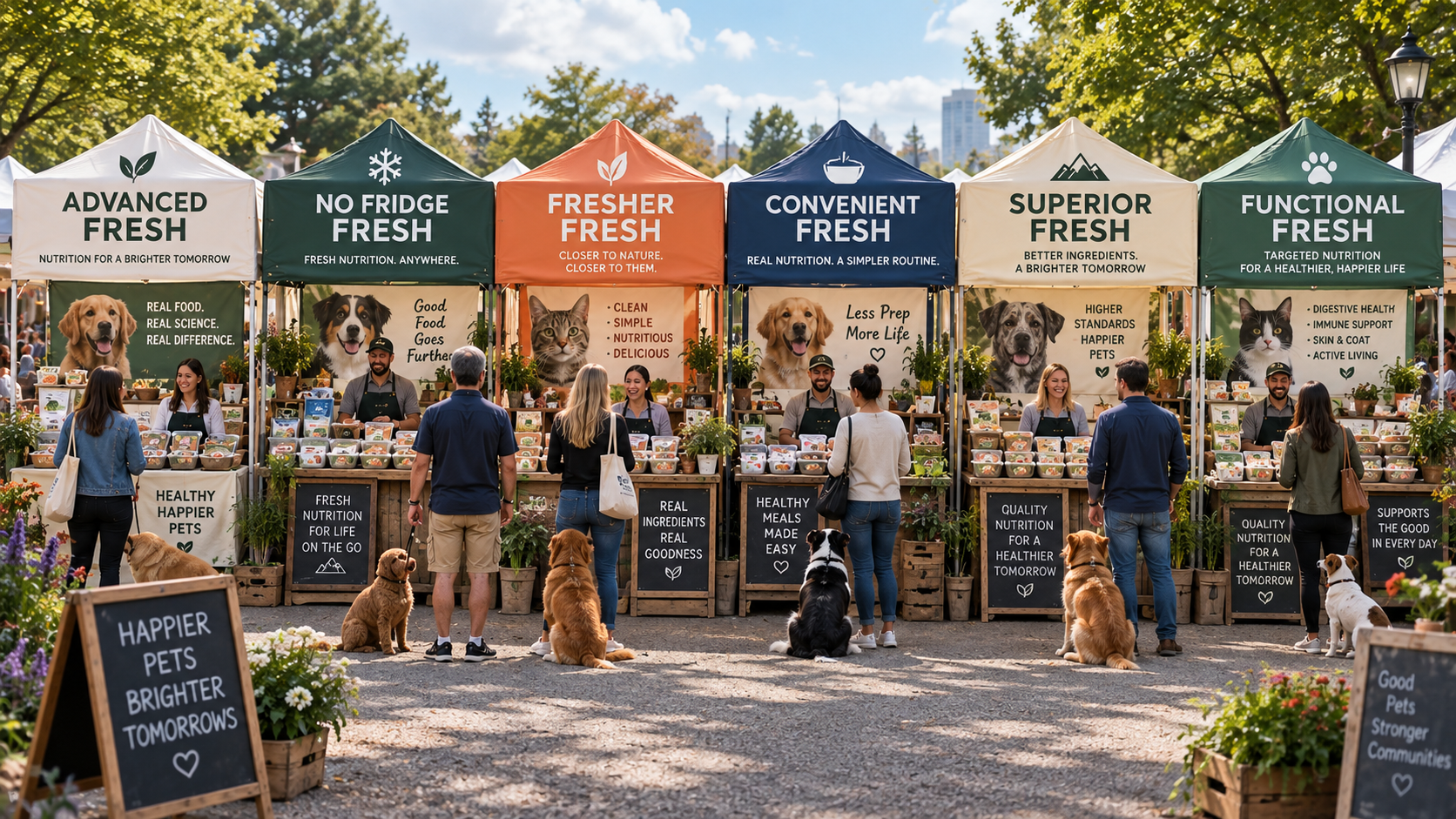
Premium pet brands have spent more than a decade expanding by segmenting the market into ever more specialized dietary propositions: grain-free, ancestral/biologically appropriate, raw, fresh, gently cooked, human-grade, limited ingredient, high protein, functional benefits, sustainably sourced, breed/life-stage solutions, probiotics, freeze-dried, etc.
However, these successful innovations also escalated the competition. The competitors then normalized them, and what began as a meaningful brand distinction increasingly became a category expectation.
Don’t get me wrong, product innovation is and will remain essential. However expecting product innovation to fuel lasting brand competitive leverage is becoming increasingly unrealistic.
In sum, here’s the strategic challenge we will examine:
- When nearly every premium pet food is nutritionally sound and on point, where should competitive advantage spring from?
- When the supply of premium pet food solutions outstrips demand and the law of economics flip, what should brands do to build and hold incremental gains?
Simply put, more brands and more SKUs and more innovation alongside enhanced nutritional claims are competing for a finite number of households, pet stomachs, shelf space and dollars. At some point, yet another product improvement stops creating proportional incremental demand. Instead it mostly redistributes existing demand. Slowing pet category growth makes this an imperative issue to confront now.
To its credit, the industry has invested enormous resources to improve what’s in the bag, can or pouch. And it worked. The nutritional quality available to pet parents is extraordinary compared with 15–20 years ago.
But there’s an unintended consequence:
- The industry’s relentless pursuit of product superiority has produced an increasingly superior and rather closely aligned field of competitors who chase each other into every innovation territory.
Here’s the current essential truth…
High protein isn’t distinctive. Functional nutrition isn’t distinctive. Probiotics aren’t distinctive. Minimally processed isn’t unique. Human-grade isn’t nearly as distinctive as it once was. Freeze-dried isn’t. Fresh is already spreading among brands. Even claims around ingredient quality, veterinary expertise, and science-backed are increasingly shared territory.
Claim proliferation is upon us. According to Innova Insights 2025 launch data, among new products carrying a high-protein benefit, 71% also carried another health claim, 64% had a digestive-health claim and nearly half added a skin-health claim. Gut-health positioning appeared on 31% of global new launches; immune and skin health each appeared on 22%.
Fresh category is the latest expansion arena:
Fresh began by successfully challenging assumptions about what pet food should be. Today fresh/frozen territory includes Freshpet, Farmer’s Dog, Ollie, JustFoodForDogs, Nom Nom and numerous others, while conventional premium manufacturers increasingly offer adjacent, similar formats. Fresh/frozen dog food posted a 24.5% CAGR from 2021–2025 versus 5.7% for the overall dog-food-and-treat category. What was once a category disruption transforms into another highly competitive segment.
The same process occurred earlier with grain-free and high-protein formulations. A claim can be true, important and compelling to consumers—and still have almost no competitive currency if a dozen brands are credibly making the same claim.
“High protein” is valuable but not differentiating.
“Science-backed” is reassuring but without being proprietary.
“Premium ingredients” is meaningful without offering separation.
“Veterinarian developed” forges trust but not ownership.
Pricing aside, what happens when brands prioritize reasons to believe over the more elusive yet critical trusted reasons to choose.
We should note, premium pet category strength continues to be a business driver. APPA reported 41% of dog owners and 38% of cat owners purchased premium food in 2024, both up from 2023.
Packaged Facts similarly found that 70% of dog and cat owners remain willing to pay more for foods offering health-and-wellness benefits. While the demand for premium benefits remains strong, what’s becoming harder is capturing a disproportionate share of that demand when so many brands make comparable benefit claims.
Let’s dive in on the underlying economic mechanism fueling current conditions
- Innovation → success → imitation → proliferation → normalization → declining differentiation creates a condition where greater marketing investment is required to deliver the same year-to-year growth report card.
When competitors quickly replicate any innovation, the category may expand but without creating durable, sustainable advantage for the innovator.
The strategic competitive question then changes from:
“What can we make that is better?”
to:
“What can we become or offer that competitors cannot easily replicate?”
Where does the next increment of value surface from when most of the new nutritional niches have already been occupied?
Alongside innovation parity, an unseen contributor is helping enable these current challenges.
Ten years ago when premiumization was gaining momentum, the demand for higher quality ingredients, sourcing, manufacturing exceeded the supply. If you went to market with an authentically better product and handled the retail distribution, support and marketing requirements with skill and creativity, you likely saw solid growth and returns.
The red hot premium pet food market attracted more competitors in the same space, so brands began to look for unique needs, gaps and marketplace niches to serve while securing separation. This also worked for a time until most of those nutritional need gaps had been satisfied.
Meanwhile many traditional barriers to entry in the pet food business have fallen.
Nutrition and science based formulators are readily available to help bring a product vision to life, while co-packers with sourcing expertise can serve as the asset light path to making a product. AI helps quickly build the business and operations plan while direct to consumer models make it considerably easier to get in front of potential customers (Packaged Facts states 39% of U.S. pet-food sales now occur online). The result is more and more new brands entering an already crowded marketplace seeking attention and share of wallet. One trip around the convention hall at SuperZoo helps verify the environment.
- When supply starts to outstrip demand, the forces of competition begin to shift. Competition turns inward. Brands rush to participate in every corner of novel innovation and you begin to see brand similarity and sameness converge.
This impacts the strategic game plan when category conventions and normalized behaviors keep everyone locked into a cycle that replicates the same go-to-market moves. It simply gets harder and harder to squeeze incremental balance sheet gains year to year when the differentiation of choices narrows. Of note, pricing power also softens when brand distinction is diminished and becomes more trivial.
Prevailing business conditions are demanding improved strategic solutions
Consider the overall industry growth status reported by Packaged Facts: U.S. pet food and treat retail sales is projected to grow just 2.1% in 2026, to $70.45 billion, with a forecasted 3.2% CAGR from 2025–2030. The trend lines show a slower pace with dog and cat food sales rising 14% in 2020, 15% in 2021 and 2022, and 13% in 2023, before decelerating to 3.7% in 2024 and an estimated 2.8% in 2025.
The supply of premium solutions continues to expand while category growth is moderating. This will simply intensify the fight for new, novel growth solutions. Now is the time to get on this.
So what’s next?
Places where the strategic pet brand building conversation can go:
Proprietary brand meaning—ideas, beliefs, cultural territory, communities and emotional propositions that aren’t bottled up in the formulation. This is a search for a ‘secret sauce’ or true north that may exist inside the organizations’ business structure, operations, behaviors, history, standards and beliefs.
Category creation—not another variant within an existing segment, but identifying an unmet pet nutrition problem that changes how stakeholders will think or behave. When most needs are already met, this is a tougher (but not insurmountable) question overall.
Authority—owning trust, credibility and belief rather than merely making claims and assertions of performance and outcome.
Business-model differentiation: experiences, services, retail models, personalization, relationships and other assets that competitors can’t duplicate simply by sending another formula to R&D.
In sum, the product still has to be excellent. Innovation remains essential. But durable advantage will increasingly come from proprietary meaning, authority, community, experience, business model, cultural relevance, category creation or some other asset competitors can’t duplicate by formulating an enhanced recipe and putting another package on the shelf.
An aligned avenue of strategic exploration: industry weaknesses and gaps
When there’s less leverage in products, the challenge to leadership teams is how to create added business value that isn’t easily over-run by competitors. Perhaps it’s time to solve systemic problems the industry faces that other brands elect to ignore or soft pedal.
If you zoom out to 30,000 feet and look at the pet food business there are numerous issues and weaknesses that your brand may be in a position to help solve, and in doing so, to step outside the conventional competition handbook to create a unique story your brand can champion.
A few examples –
- Sustainability is an enormous hole the industry has talked around the edges of but no one leads at the strategic level to authentically resolve the supply chain (system 3) impacts.
- While AAFCO standards enforce conformity on nutrition specifications monitored by state and federal regulators, still quality varies without verifiable consumer assurance of exactly what they’re getting. Is transparency really transparent?
- The conventions of pet retail and product form hold the industry in a commodity-like grip cycle of bags, cans and pouches that present the product in the same fashion brand to brand. At times category conventions beg for fresh thinking.
These are not simple challenges, but one thing is for certain: there is a requirement now for real strategic work to investigate, interrogate and determine what the next roadmap to brand growth will look like. Here are some of the elements worthy of deep dive analysis:
What does the brand currently own?
Which claimed advantages are proprietary versus replicable?
Where has category convergence eroded differentiation?
Which latent brand assets have greater strategic potential?
What consumer/category white space could the brand credibly occupy?
What organizing proposition could drive innovation, communications, retail and go-to-market?
The next growth recipe may not be another recipe at all.
We should begin by answering a harder question: What can your brand credibly own that competitors cannot readily appropriate?
For premium pet brands fighting over increasingly similar nutritional territory, finding the answer may become one of the most consequential growth assignments ahead.
Looking for more food for thought? Subscribe to the Emerging Trends Report.
Bob Wheatley is the CEO of Chicago-based Emergent. Traditional brand marketing often sidesteps more human qualities that can help consumers form an emotional bond. Yet brands yearn for authentic engagement, trust and a lasting relationship with their customers. For more information, contact Bob@Emergent-Comm.com and follow on Twitter @BobWheatley.